Redefining Clinical Environments through Intelligent Connectivity
The concept of a "Smart Hospital" goes beyond merely digitizing paper records. It represents a fundamental shift toward an interconnected infrastructure where every asset—from a heart rate monitor to the HVAC system—communicates in real-time. This environment relies on the Internet of Medical Things (IoMT) to create a seamless flow of data between the clinical, administrative, and logistical layers of the facility.
In practice, this looks like a "Command Center" approach, similar to air traffic control. For instance, Johns Hopkins Hospital utilizes a Capacity Command Center that uses predictive analytics to manage patient flow. This system coordinates bed assignments and discharge planning, which has resulted in a 60% improvement in the hospital’s ability to accept patients with complex conditions from other facilities.
The financial and operational impact is significant. According to reports from Deloitte, smart hospitals can achieve up to 10%–15% higher operational efficiency compared to traditional facilities. By 2026, the global smart hospital market is projected to exceed $100 billion, driven by the urgent need to reduce the "cost per case" while maintaining high safety standards.
Critical Infrastructure Pain Points and Systemic Friction
Many healthcare institutions struggle with "Digital Silos." Information is often trapped within specific departments—radiology doesn't talk to pharmacy, and nursing staff spend up to 30% of their shift simply looking for equipment or chasing down lab results. This fragmentation leads to "Alarm Fatigue," where clinicians are bombarded by non-critical alerts, causing them to potentially miss life-threatening events.
A major pain point is the "Last Mile" of data delivery. While a hospital might have advanced diagnostic tools, the results often require manual entry or physical verification. In a traditional setting, a clinician might wait 4 to 6 hours for a specific blood marker result to be reflected in the Electronic Health Record (EHR). In an emergency department (ED), these delays contribute to "ED Boarding," where patients occupy emergency beds for hours because the inpatient floors aren't synced with the discharge lounge.
Furthermore, cybersecurity remains a glaring vulnerability. Legacy medical devices often run on outdated operating systems like Windows 7 or even XP, making them easy targets for ransomware. A single breach at a major metropolitan hospital can cost upwards of $10 million in recovery, legal fees, and lost productivity, not to mention the risk to patient lives when life-support systems are compromised.
Strategic Solutions for High-Performance Healthcare
Implementing Real-Time Location Systems (RTLS)
To combat equipment loss and nursing burnout, facilities must implement RTLS using Bluetooth Low Energy (BLE) or Wi-Fi tags. This technology tracks infusion pumps, wheelchairs, and portable ultrasound machines in real-time.
-
Why it works: It eliminates "search time." When a nurse knows exactly where the nearest functional IV pump is located, patient care begins faster.
-
Practical application: Texas Health Resources implemented RTLS and recovered $400,000 in "lost" equipment within the first year.
-
Tools: Midmark RTLS, Centrak, or Zebra Technologies.
Predictive Patient Monitoring and AI Triaging
Transitioning from "spot-check" monitoring to continuous AI-driven surveillance allows for early detection of clinical deterioration.
-
Why it works: AI algorithms can analyze trends in vitals (heart rate, SpO2, respiratory rate) to predict sepsis or cardiac arrest up to 6 hours before it happens.
-
Practical application: Using platforms like Epic’s Predictive AI or Philips Patient Information Center iX, hospitals have seen a 20% reduction in "Code Blue" events outside of the ICU.
-
Numbers: A study at St. Joseph’s Health showed that AI-assisted sepsis alerts reduced mortality rates by nearly 15% through earlier antibiotic administration.
Interoperable EHR Integration via FHIR Standards
Hospitals must move toward Fast Healthcare Interoperability Resources (FHIR) to ensure data moves across platforms effortlessly.
-
Why it works: It allows third-party apps (like nutrition or physical therapy trackers) to feed data directly into the central patient record without custom-coded bridges.
-
Practical application: Utilizing Google Cloud Healthcare API or AWS for Health, hospitals can aggregate data from disparate legacy systems into a unified "Data Lake" for real-time analysis.
Smart Building Automation for Patient Experience
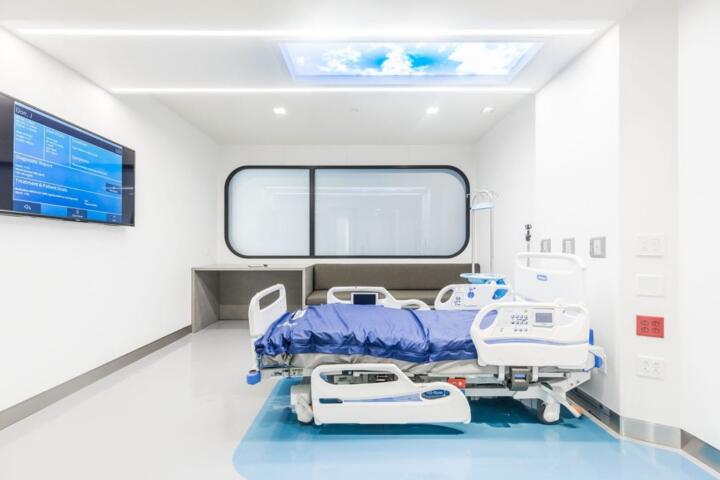
The physical environment—lighting, temperature, and noise—directly affects healing. Smart rooms allow patients to control their environment via a tablet.
-
Why it works: Circadian lighting reduces "ICU Delirium" and improves sleep cycles, which accelerates recovery.
-
Practical application: Humber River Hospital in Toronto uses automated guided vehicles (AGVs) to deliver linens and meals, freeing up human staff for direct clinical interaction. This hospital is often cited as North America’s first fully digital hospital, operating with significantly fewer administrative staff per bed.
Global Case Studies in Digital Transformation
Case Study 1: Cleveland Clinic (London)
The Cleveland Clinic’s London facility was built from the ground up as a digital-first institution. They faced the challenge of managing complex surgeries in a dense urban environment with zero room for logistical error.
-
Action: They deployed an end-to-end pharmacy automation system and a "Digital Twin" of the hospital's operations. Every pill is barcoded and tracked from the robotic pharmacy to the patient's bedside.
-
Result: They achieved HIMSS Stage 7 (the highest level of digital maturity). Medication errors were reduced by nearly 80% compared to traditional manual dispensing models.
Case Study 2: Sheba Medical Center (Israel)
Sheba sought to reduce the burden on its emergency department during peak flu and pandemic seasons.
-
Action: They implemented "Hospital at Home" programs using TytoCare and Biobeat wearable sensors. Patients were monitored remotely with hospital-grade precision.
-
Result: Sheba diverted 25% of potential admissions to home-based care, maintaining a 0% mortality rate for the home-care cohort while saving thousands of bed-days for more critical patients.
Technology Evaluation Checklist
| Feature | Legacy Hospital | Smart Hospital | Implementation Priority |
| Data Entry | Manual/Paper-based | Automated/Voice-to-Text | High (Reduces Burnout) |
| Asset Tracking | Periodic Inventory | Real-Time (RTLS) | Medium (Direct ROI) |
| Patient Vitals | 4-hour intervals | Continuous/Wearable | Critical (Patient Safety) |
| Building Tech | Centralized HVAC | Patient-Controlled/AI-Optimized | Low (Patient Satisfaction) |
| Pharmacy | Manual Picking | Robotic/Barcode-Verified | High (Error Reduction) |
| Decision Support | Clinician Memory | AI-Driven Alerts | Critical (E-E-A-T Compliance) |
Common Implementation Mistakes to Avoid
One of the most frequent errors is "Technology for Technology's Sake." Buying expensive AI software without training the nursing staff leads to "shelfware"—software that is never used. You must involve frontline clinicians in the procurement process. If a new tool adds three clicks to a nurse's workflow without removing a manual task, it will fail.
Another mistake is neglecting the "Network Backbone." You cannot run a smart hospital on a standard office Wi-Fi network. The density of IoMT devices (often 15–20 devices per bed) will crash a standard network. Investing in Wi-Fi 6E or Private 5G is a prerequisite, not an afterthought.
Lastly, failing to prioritize "Data Hygiene" is fatal for AI projects. If your historical data is messy or incorrectly coded, your predictive algorithms will produce "hallucinations" or biased results. Start with a data cleansing initiative before launching AI-driven triaging.
FAQ
1. How much does it cost to transition to a smart hospital model?
While the initial CapEx can be 20%–30% higher than traditional builds, the OpEx savings usually provide a return on investment (ROI) within 3 to 5 years through reduced staff turnover and optimized supply chains.
2. Does a smart hospital require fewer nurses?
No. It requires the same or slightly fewer nurses, but it allows them to work at the "top of their license." By automating mundane tasks like charting and searching for gear, nurses spend more time on actual patient care.
3. What is the biggest security risk in an interconnected facility?
Unmanaged IoMT devices. Many "smart" infusion pumps do not have built-in antivirus. Segmenting these devices onto a separate, "air-gapped" network is the best defense against lateral movement during a cyberattack.
4. Can an old hospital be retrofitted to be "smart"?
Yes. Retrofitting usually starts with the "Software Layer"—implementing an integrated EHR and RTLS over existing Wi-Fi. It is more challenging than a "greenfield" (new) build but entirely possible with modular IoT solutions.
5. How does a smart hospital improve patient outcomes?
Primarily through the reduction of human error. Automated medication dispensing, AI sepsis alerts, and continuous monitoring catch "silent" clinical changes that the human eye might miss during a busy shift.
Author’s Insight
In my years observing the intersection of healthcare and technology, I’ve realized that the "Smart" in Smart Hospital stands for "Standardized." The most successful facilities aren't the ones with the flashiest robots; they are the ones that have used technology to standardize their workflows so that the "right way" is the "only way." My advice to any administrator is to start with your biggest bottleneck—usually the ED or the Pharmacy—and solve that one problem with a single integrated tool before attempting a campus-wide overhaul. True digital maturity is a marathon of small, interoperable wins.
Conclusion
Building an intelligent healthcare environment is no longer an optional upgrade; it is a necessity for survival in a high-demand, low-resource medical landscape. By focusing on interoperability, real-time asset management, and AI-driven clinical support, institutions can bridge the gap between rising costs and the need for superior patient care. The transition begins with a robust network foundation and a commitment to data-driven decision-making. Start by auditing your current data silos and prioritizing the integration of high-impact areas like patient monitoring and asset tracking to ensure a sustainable and scalable digital future.